
👤Author
Name: Ana Maria DUMITRAȘCU
Affiliation: Universitatea Transilvania din Braşov [Transilvania University of Brașov], România
Contact: ana.dumitrascu@unitbv.ro
📄Article
Citation Recommendation: Dumitrașcu, Ana-Maria. ‟Dialectique de l’ecriture kunderienne: Bohème – France, 1968-2014”. Synthesis, 4 / 2025: 112-131.
Pages: 112-131
Language: French
URL:https://synthesis.ro/pdf/2025/4/5_Dumitrascu.pdf
Abstract
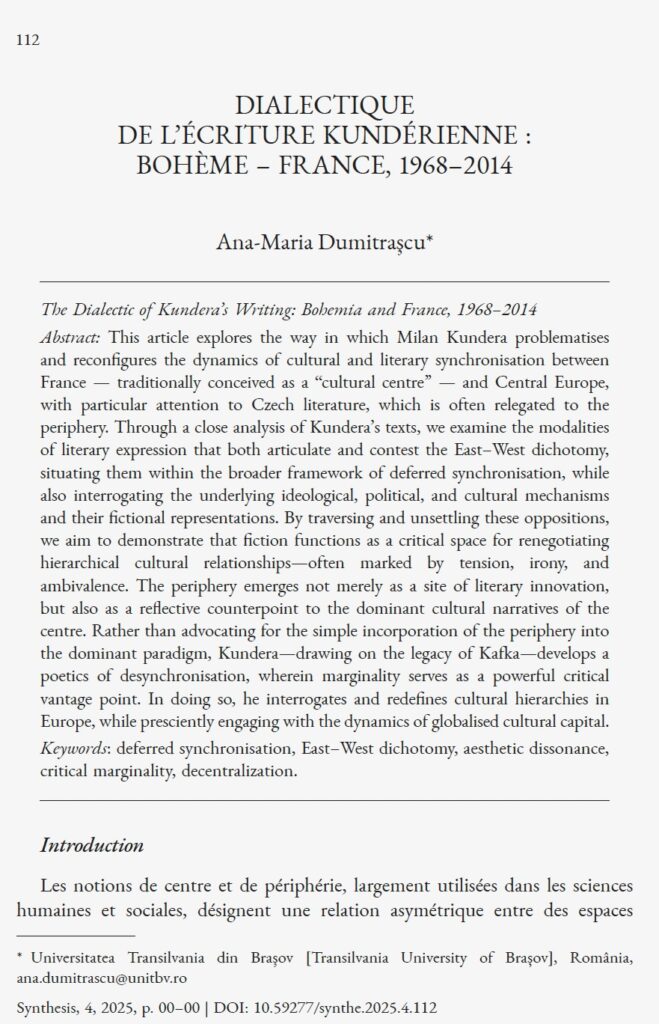
This article explores the way in which Milan Kundera problematises and reconfigures the dynamics of cultural and literary synchronisation between France — traditionally conceived as a “cultural centre” — and Central Europe, with particular attention to Czech literature, which is often relegated to the periphery. Through a close analysis of Kundera’s texts, we examine the modalities of literary expression that both articulate and contest the East–West dichotomy, situating them within the broader framework of deferred synchronisation, while also interrogating the underlying ideological, political, and cultural mechanisms and their fictional representations. By traversing and unsettling these oppositions, we aim to demonstrate that fiction functions as a critical space for renegotiating hierarchical cultural relationships—often marked by tension, irony, and ambivalence. The periphery emerges not merely as a site of literary innovation, but also as a reflective counterpoint to the dominant cultural narratives of the centre. Rather than advocating for the simple incorporation of the periphery into the dominant paradigm, Kundera—drawing on the legacy of Kafka—develops a poetics of desynchronisation, wherein marginality serves as a powerful critical vantage point. In doing so, he interrogates and redefines cultural hierarchies in Europe, while presciently engaging with the dynamics of globalised cultural capital.
Key-words: deferred synchronisation, East–West dichotomy, aesthetic dissonance, critical marginality, decentralization
Bibliography
ADORNO, Theodor W., Théorie esthétique, édition originale Ästhetische Theorie, édité par Rolph Tiedemann, traduit de l’allemand par Marc Jimenez, Collection d’esthétique, Paris, Klincksieck, 2011.
BAKHTINE, Mikhaïl, Esthétique et théorie du roman, trad. du russe par Daria Olivier, Collection Bibliothèque des Idées, Paris, Gallimard, 1987.
BHABHA, Homi K., Les lieux de la culture Une théorie postcoloniale, trad. Françoise Bouillot, Paris, Éditions Payot, 2007.
CASANOVA, Pascale, La République mondiale des lettres, Paris, Seuil, 1999.
CHAKRABARTY, Dipesh, Provincialiser l’Europe La pensée postcoloniale et la différence historique, trad. par O. Ruchet et N. Vieillescazes, Paris, Éd. Amsterdam, [2000] 2009
DELEUZE, Gilles, GUATTARI, Félix, Kafka: Pour une littérature mineure, Paris, Les Editions de Minuit, 1975.
FABIAN, Johannes, Le Temps et les Autres Comment l’anthropologie construit son objet, trad. de l’anglais par E. Henry-Bossonney et B. Müller, avant-propos d’A. Bensa. Toulouse, éditions Anacharsis, coll. Griffe essais, 2e édition.
GRAMSCI, Antonio, Cahiers de prison Anthologie, traduction de Jean-Yves Frétigné et al., collection « Bibliothèque des idées », Paris, Folio, 2021.
HAZARD, Paul, La crise de la conscience européenne, 1680-1715, Paris, Le Livre de Poche, 1994.
KUNDERA, Milan, Œuvres La Pléiade, Tomes I–II, Paris, Gallimard, 2016.
———, « Un Occident kidnappé ou la tragédie de l’Europe centrale », Le Débat, novembre 1983/5 n° 27, p. 25, réimprimé à Paris, Gallimard, 2021, et disponible aussi sur https://shs.cairn.info/revue-le-debat-1983-5-page-3?lang=fr&wt.src=pdf
MATÍAS E., Margulis, The Global Political Economy of Raúl Prebisch, New York,
Routledge, 2017
MIGNOLO, Walter D., « Géopolitique de la connaissance, colonialité du pouvoir et différence coloniale », Paris, Multitudes 2001/3 (n° 6), p. 56-71, traduit par Jean
Poitier, https://shs.cairn.info/revue-multitudes-2001-3-page-56?lang=fr
MORETTI, Franco, “Conjectures on World Literature”, London, New Left Review, no. 1, 2000, pp. 54–68. À consulter en ligne sur https://iedamagri.wordpress. com/wp-content/uploads/2017/01/franco-moretti.pdf
RICARD, François, Le Dernier après-midi d’Agnès: Essai sur l’œuvre de Milan Kundera Collection Arcades, Gallimard, 2003.
SAID, Edward W., L’Orientalisme: L’Orient créé par l’Occident. Traduit par Catherine Malamoud, Paris, Points, coll. « Points Essais », 2015.
ŠMÍDMAJER, Miloslav (réal.), Milan Kundera: From the Joke to Insignificance, Télévision tchèque/Bio Illusion, 2021.
TERIAN, Andrei, ,,The Poetics of the Hypercycle in Mircea Cărtărescu’s Solenoid”, Life Writing, 19(3), 323–340, 2020, https://doi.org/10.1080/14484528.2020.1747351
WALLERSTEIN, Immanuel, Le Système du monde du XVe siècle à nos jours: L’économiemonde capitaliste,traduit par Alain Joxe, Paris, Flammarion, coll. « Champs », 2011. Publié à l’origine sous le titre The Modern World-System, en 1974.
- DOI: 10.59277/synthe.2025.4.112
- https://doi.org/10.59277/synthe.2025.4.112