
👤Author
Name: Michèle Fornhoff-Levitt
Affiliation: Sorbonne Université / Université libre de Bruxelles, France / Belgium
Contact: michele.fornhoff@ulb.be
📄Article
Citation Recommendation: Fornhoff-Levitt, Michèle. “Staging Synchronization: Yiddish Theatre in the Interwar Paris and the Dynamics of Cultural Negotiation”. Synthesis, 4 / 2025: 161-201.
Pages: 161-201
Language: English
URL:https://synthesis.ro/pdf/2025/4/7_Fornhoff-Levitt.pdf
Abstract
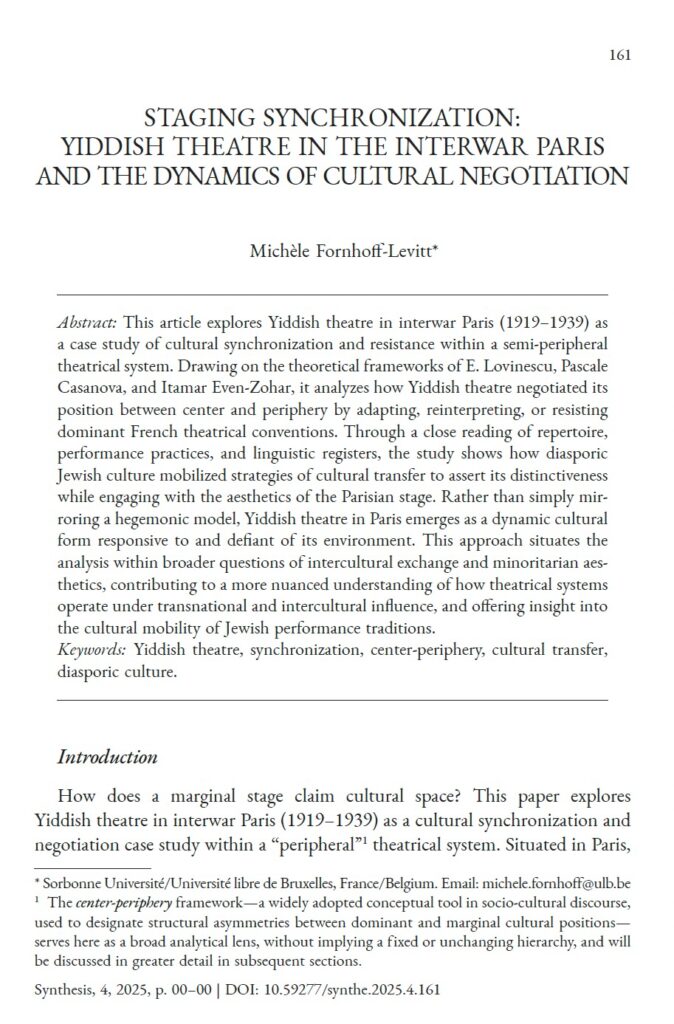
This article explores Yiddish theatre in interwar Paris (1919–1939) as a case study of cultural synchronization and resistance within a semi-peripheral theatrical system. Drawing on the theoretical frameworks of E. Lovinescu, Pascale Casanova, and Itamar Even-Zohar, it analyzes how Yiddish theatre negotiated its position between center and periphery by adapting, reinterpreting, or resisting dominant French theatrical conventions. Through a close reading of repertoire, performance practices, and linguistic registers, the study shows how diasporic Jewish culture mobilized strategies of cultural transfer to assert its distinctiveness while engaging with the aesthetics of the Parisian stage. Rather than simply mirroring a hegemonic model, Yiddish theatre in Paris emerges as a dynamic cultural form responsive to and defiant of its environment. This approach situates the analysis within broader questions of intercultural exchange and minoritarian aesthetics, contributing to a more nuanced understanding of how theatrical systems operate under transnational and intercultural influence, and offering insight into the cultural mobility of Jewish performance traditions.
Key-words: Yiddish theatre, synchronization, center-periphery, cultural transfer, diasporic culture
Bibliography
ASCH , Scholem, Leksikon fun der nayer yidisher literatur, vol. 1, New York, Alveltlekhn Yidishn Kultur-Kongres, 1956
ASLAN, Odette, « Le dibbouk d’An-ski et la réalisation de Vakhtangov », Les voies de la création théâtrale, N° 7, Paris, Éditions du Centre National de la Recherche Scientifique, 1979.
« À l’Atelier—Le Dieu de Vengeance, pièce en 3 actes de Schalom Asch, traduction de L. Blumenfeld », in Comœdia, 23.4.1925.
AVIVITH, Shoshana, « Les origines d’Habima », Le Monde juif, N° 9–10, 1947 BATY, Gaston, Rideau baissé,Paris, Bordas, 1949.
BAUMGARTEN, Jean, « Le Purim-shpil et la tradition carnavalesque juive », Pardès, N° 15, 1992
BECHTEL, Delphine, La Renaissance culturelle juive Europe centrale et orientale (1897–1930), Paris, Éditions Belin, 2002.
BENBASSA, Esther, Histoire Des Juifs de France, Paris, Seuil, 2000.
BERKOWITZ, Joel, HENRY, Barbara (eds.), Inventing the Modern Yiddish Stage, Detroit, Wayne State University Press, 2012.
BIAL, Henry, Acting Jewish Negotiating Ethnicity on the American Stage and Screen, Ann Arbor, The University of Michigan Press, 2008.
BRISSON, Pierre, « Chronique théâtrale. Studio des Champs-Élysées—Le dibbouk », Le Temps, 6.2.1928.
BROOKS, Peter, The Melodramatic Imagination Balzac, Henry James, Melodrama, and the Mode of Excess, New Haven and London, Yale University Press, [1976] 1995
CAPLAN, Debra, Yiddish Empire: The Vilna Troupe, Jewish Theater, and the Art of Itinerancy, Ann Arbor, University of Michigan Press, 2021.
CASANOVA, Pascale, La République mondiale des lettres, Paris, Éditions du Seuil, 1999
———, The World Republic of Letters, M.B. DeBevoise (trad.), Cambridge MA, Harvard University Press, 2004.
CODDE, Philippe, “Polysystem theory Revisited”, Poetics Today, Vol. 24, n°1, Spring 2003.
DEBORD, Guy, La société du spectacle, Paris, Buchet-Chastel, 1967.
EVEN-ZOHAR, Itamar, “Polysystem Theory”, Poetics Today, Vol. 1, N° 1/2, Autumn 1979
FONDANE, Benjamin, Cahiers juifs, 2nd year, vol. II, 1934.
FORNHOFF-LEVITT, Michèle, Le théâtre yiddish de l’entre-deux-guerres à Paris (1919-1939): La judéité mise en scène, thèse doctorale, Sorbonne Université/ Université libre de Bruxelles, 4 December 2023.
GLEDHILL, Christine and WILLIAMS, Linda (eds.), Melodrama Unbound: Across History, Media, and National Cultures, New York, Columbia University Press, 2018.
GOETSCHEL, Pascale, Une autre histoire du théâtre Discours de crise et critiques spectaculaires—France XVIIIe–XXIe siècle, Paris, CNRS Éditions, 2020.
GOETSCHEL, Pascale, YON, Jean-Claude, Directeurs de théâtre XIXe–XXe siècles Histoire d’une profession, Paris, Publications de la Sorbonne, 2008.
GUERIN, Jean-Yves, Le théâtre en France de 1914 à 1950, Paris, Honoré Champion Éditeur, 2016.
HEMINGWAY, Ernest, Paris est une fête!, Marc Saporta (trad.), Paris, Gallimard, [1964] 2011.
HENRY-MARX, « Le Dieu de Vengeance », in Menorah, n°10, 1551925
LEVINE, Lawrence W., Highbrow/Lowbrow: The Emergence of Cultural Hierarchy in America, Cambridge, Harvard University Press, 1988.
LOVINESCU, E, The History of Modern Romanian Civilization. Translated by Alina Branda. Budapest, Central European University Press, 2022.
———, “The History of Modern Romanian Civilization”, Translated by Mária Kovács. In Modernism: Representations of National Culture, edited by Ahmet Ersoy, Maciej Górny, and Vangelis Kechriotis, Budapest, Central European University Press, 2010.
MAIORESCU, T., “Against the Contemporary Direction in Romanian Culture,” translated by Mária Kovács, in Modernism: Representations of National Culture, Ahmet Ersoy, Maciej Górny, and Vangelis Kechriotis (eds.), Budapest, Central European University Press, 2010.
MANEGAT, Jean, « Dans les subventionnés », La Rampe, 1.10.1928.
MEYER-PLANTUREUX, Chantal, Antisémitisme et homophobie Clichés en scène et à l’écran, Paris, CNRS Éditions, 2019.
———, Les enfants de Shylock ou l’antisémitisme sur scène, Bruxelles, Éditions Complexe, 2005.
MOÏCHER SFORIM, Mendele, Les voyages de Benjamin III, trad. du yiddish par A. Mandel, Paris, Circé, [1878] 1960.
MORETTI, Franco, “Conjectures on World Literature”, New Left Review, n° 1, January–February 2000.
MOREVSKI, Abraham, There and Back: Memories and Thoughts of a Jewish Actor, Vol. 2, London, J. Clarke, 1967.
———, Shylock and Shakepeare, St. Louis, Fireside Books, 1967.
MOUSSINAC, Léon, Avec les comédiens soviétiques en tournée, Paris, Éditions Sociales Internationales, 1935.
NIBORSKI, Itshok, DEMONICO, Aristide, Théâtre Yiddish, Tome II (Sholem An-Ski, Isaac-Leyb Peretz, Aaron Zeitlin), Paris, L’Arche, 1989.
PENTZELL, Raymond, “Firmin Gémier and Shakespeare for Everybody”, in The Tulane Drama Review, vol. 11, N° 4, Summer 1967.
PICON-VALLIN, Béatrice, LIEBER Gérard (éds.), Gaston Baty, Arles, Actes Sud, 2016.
PINSKI, Dovid, ASCH, Scholem, HIRSCHBEIN, Peretz, RABINOWITSCH, Solomon J., Six Plays of the Yiddish Theatre (I), transl. from Yiddish by Isaac Goldberg, Boston, John W. Luce and Company, 1916.
PRIŁUCKI, Noach, “Di yidishe binesprakh”, in Michal Weichert, Buch II, Yidish theater, Vilna, Nakladem Wilenskuevo, april-may-juni 1927.
ROSKIES, David G., The Jewish Search for a Usable Past, Bloomington, Indiana University Press, 1999.
SHOR, Moyshe, Di Rumenishe khasene: operete in dray aktn, Varsha, Farlag S. Goldfarb, 1925.
SPERO, Yakov, “Tsen yor PYAT”, Parizer shriftn; Organ funem Farband fun Yidishe Kultur-Gezelshaftn in Frankraykh, n° 1, 1945
UNDERWOOD, Nick, Yiddish Paris: Staging Nation and Community in Interwar France, Bloomington, Indiana University Press, 2022.
« Un rôle: Shylock », Gémier, entretiens réunis par Paul Gsell, Paris, Grasset, 1925.
WALLERSTEIN, Immanuel, The Modern World-System I: Capitalist Agriculture and the Origins of the European World-Economy in the Sixteenth Century, New York, Academic Press, 1974.
WEINBERG, David, Les Juifs à Paris de 1933 à 1939, Paris, Calmann-Lévy, 1974.
WISNER, René, « Le Dibbouk », Menorah, 7e année, n° 4, 15.2.1928.
YON, Jean-Claude, « Théâtromanie, société de spectacle. Une analyse alternative de l’histoire des spectacles », Dix-huitième siècle, n° 49, 2017.
- DOI: 10.59277/synthe.2025.4.161
- https://doi.org/10.59277/synthe.2025.4.161